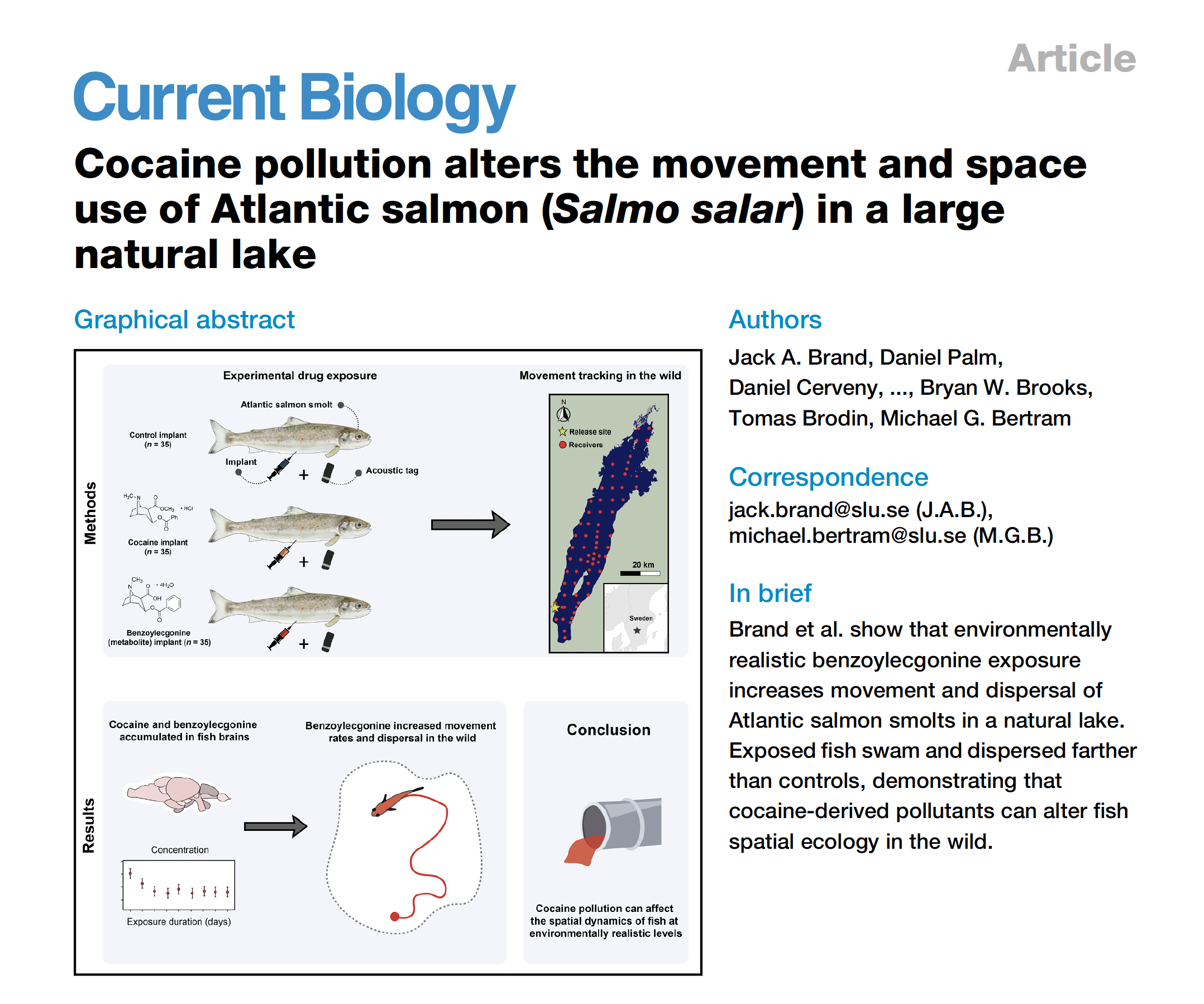
Cocaine pollution and salmon behaviour paper in Current Biology
Brand, J.A., Palm, D., Cerveny, D., Michelangeli, M., Bose, A.P.H., McCallum, E.S., Hellström, G., Fick, J., Brooks, B.W., Brodin, T., Bertram, M.G. 2026. Cocaine pollution alters the movement and space use of Atlantic salmon (Salmo salar) in a large natural lake. Curr. Biol. 36, 2018–2027. https://doi.org/10.1016/j.cub.2026.03.026 | PDF
ABSTRACT
Cocaine and its metabolites are increasingly being detected in aquatic environments worldwide. While previous research has demonstrated that these substances can affect brain function and behavior in wildlife, this research has exclusively been conducted under artificial laboratory conditions. How cocaine pollution affects animal behavior in the wild is, thus, unknown. Here, we combine slow-release chemical implants with acoustic telemetry tracking to reveal how environmentally realistic levels of cocaine and its main metabolite, benzoylecgonine, affect the movement of Atlantic salmon (Salmo salar) smolts in a large natural lake (Lake Vättern, Sweden). Benzoylecgonine exposure increased weekly movement rates of fish in the wild, with exposed fish swimming up to ∼1.9 times farther per week relative to controls. In addition, benzoylecgonine-exposed fish dispersed up to ∼12.3 km farther than control conspecifics. These results indicate that cocaine-derived pollutants can alter fish spatial ecology, potentially influencing habitat use, trophic interactions, and population-level dispersal patterns in natural ecosystems.