New mDNA introgression paper out in TREE
Brand, J.A., Bertram, M.G., Bolstad, G.H., Brodin, T., Camus, M.F., Hagen, I.J., Havird, J.C., Hill, G.E., Hindar, K., Iverson, E.N.K., Kannangara, J.R., Karlsson, S., Wacker, S., Dowling, D.K. 2026. The importance of mitochondrial DNA introgression for conservation. Trends Ecol. Evol. 41, 775–787. https://doi.org/10.1016/j.tree.2026.04.017 | PDF
ABSTRACT
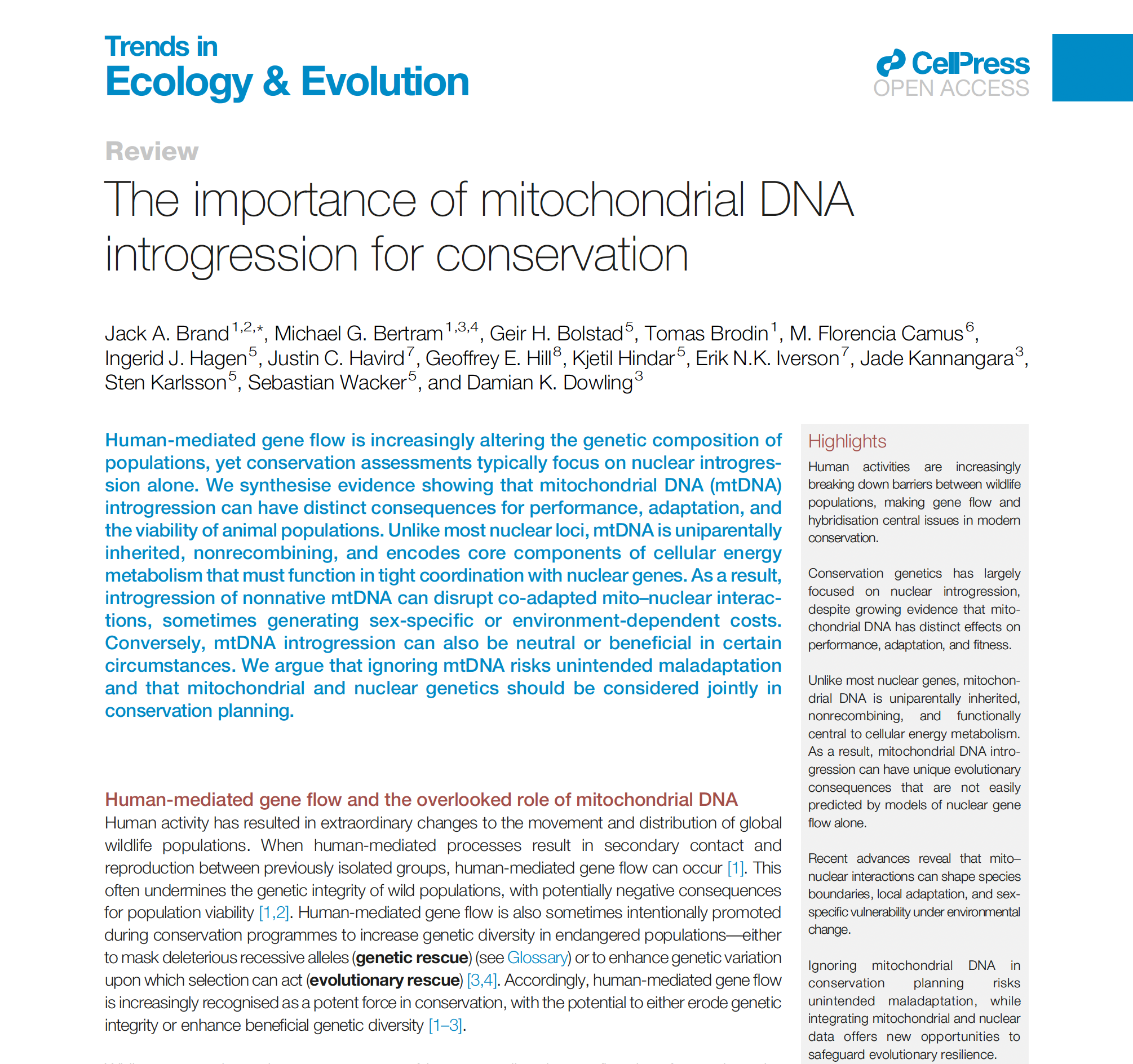
Human-mediated gene flow is increasingly altering the genetic composition of populations, yet conservation assessments typically focus on nuclear introgression alone. We synthesise evidence showing that mitochondrial DNA (mtDNA) introgression can have distinct consequences for performance, adaptation, and the viability of animal populations. Unlike most nuclear loci, mtDNA is uniparentally inherited, nonrecombining, and encodes core components of cellular energy metabolism that must function in tight coordination with nuclear genes. As a result, introgression of nonnative mtDNA can disrupt co-adapted mito–nuclear interactions, sometimes generating sex-specific or environment-dependent costs. Conversely, mtDNA introgression can also be neutral or beneficial in certain circumstances. We argue that ignoring mtDNA risks unintended maladaptation and that mitochondrial and nuclear genetics should be considered jointly in conservation planning.