New paper on the behavioural diversity of fishes out in Fish and Fisheries
Prchalová, M., Arlinghaus, R., Westrelin, S., Jarić, I., Bertram, M.G., Alós, J., Baktoft, H., Brand, J.A., Brodin, T., Cordero-Rivera, A., Feldmann, C., Futamura, R., Hont, S., Klamser, P., Nilsen, C.I., Mourier, J., Gjelland, K.Ø., Olsen, E.M., Pengal, P., Rabaneda-Bueno, R., Říha, M., Rueger, T., Schielzeth, H., Signaroli, M., Smederevac-Lalić, M., Monk, C.T. 2026. Behavioural diversity of fishes: concepts, drivers, and its role in conservation and management. Fish Fish. 27, 1245–1268. https://doi.org/10.1111/faf.70107 | PDF
ABSTRACT
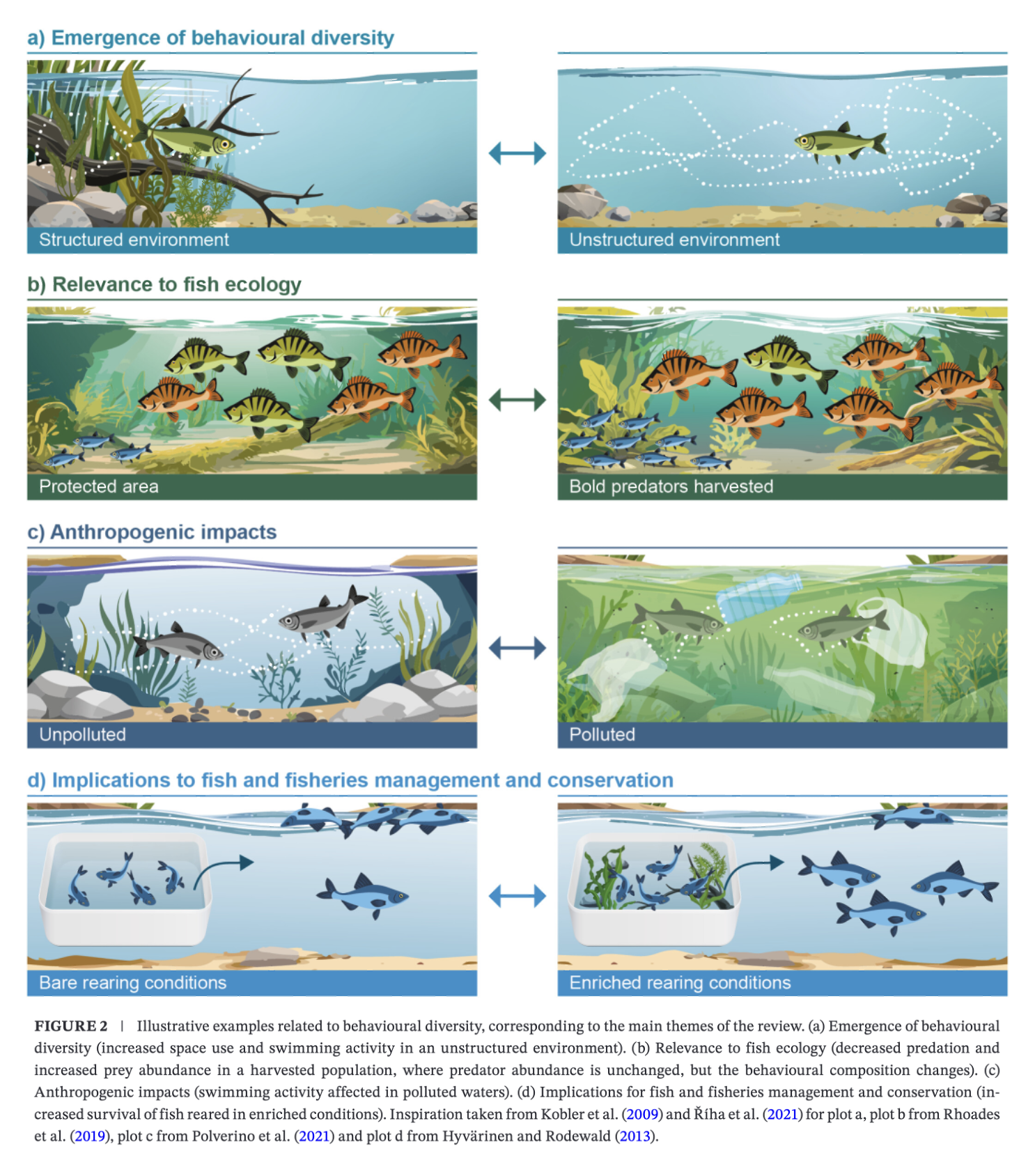
Human activity has altered nearly all ecosystems on Earth, contributing to substantial biodiversity loss across taxonomic, genetic and functional dimensions, from the intraspecific to the ecosystem scale. Yet some components of biodiversity remain hidden or underappreciated, including behavioural diversity. Behaviour is often among the earliest whole-organism responses to environmental change, and diversity in behaviour can occur within individuals, among individuals, among populations and across communities and ecosystems. This variation may influence growth, survival, reproduction, ecological interactions and responses to anthropogenic pressures, although its effects on population stability and resilience are likely context-, scale- and component-dependent. In this review, we examine behavioural diversity in fishes, defined here as variation in behavioural traits across levels of biological organisation, from individuals to ecosystems. Our review has two complementary aims. First, we provide a conceptual overview of behavioural diversity, clarify how it differs from related constructs such as personality, plasticity, and behavioural syndromes, and summarise the evolutionary, ontogenetic, ecological, stochastic and anthropogenic processes that generate or erode it. Second, we evaluate why behavioural diversity matters for fish ecology, fisheries management, aquaculture, restoration and conservation. We conclude by identifying key research needs, including improved quantification, stronger empirical links between behavioural diversity and ecological outcomes, and the development of management approaches sensitive to behavioural diversity. More explicit consideration of behavioural diversity should improve our ability to predict fish behavioural diversity responses and to design conservation and management measures that account for variation rather than only average behavioural responses.