New predator–prey paper in TREE
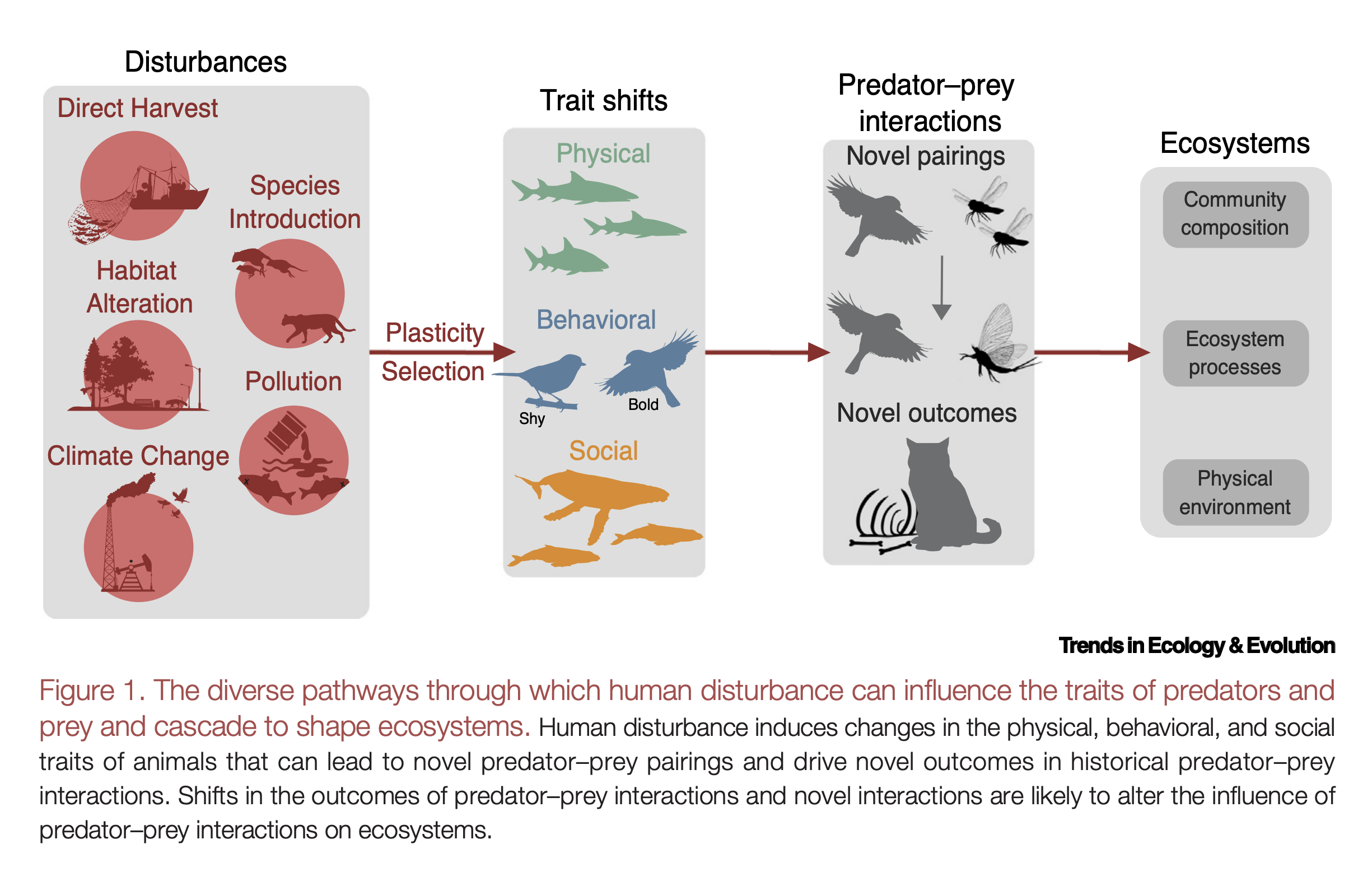
Wooster, E.I.F., Jolly, C.J., Nimmo, D.G., Ashton, B.J., Cantor, M., Whiting, M.J., Kopf, R.K., Des Roches, S., Carthey, A.J.R., Stanton, L.A., Ritchie, E.G., Bertram, M.G., Gaynor, K.M. 2026. Human-induced trait shifts reshape predator–prey interactions. Trends Ecol. Evol. https://doi.org/10.1016/j.tree.2026.01.005
ABSTRACT
For millions of years, predators and their prey have been locked in an evolutionary arms race: adaptive changes in one favor compensatory adaptations in the other. Humans have also been powerful agents of selection, reshaping the distribution of traits in animal populations. These human-induced trait shifts can disrupt predator–prey interactions, with cascading effects on ecological communities and ecosystems. We synthesize emerging evidence demonstrating that anthropogenic pressures alter physical, behavioral, and social traits relevant to predator–prey dynamics. We provide a framework for predicting the outcomes of trait shifts and a roadmap for advancing this emerging field of research. Incorporating human-induced trait changes into interaction models is essential for forecasting and conserving ecological function in a rapidly changing world.