Horizon Scanning Perspective article out in ES&T
Sigmund, G., Barra, R.O., Bertram, M.G., Diamond, M.L., Ford, A.T., Imamoğlu, I., Li, J., Lohmann, R., Schäffer, A., Scheringer, M., Šebková, K., Starling, M.C.V.M., Suzuki, N., Vlahos, P., Weber, R., Brooks, B.W. 2026. Aligning horizon scanning approaches with differing needs and topics at the science–policy interface on chemicals, waste, and pollution. Environ. Sci. Technol. 60, 20174–20181. https://doi.org/10.1021/acs.est.6c06644 | PDF
ABSTRACT
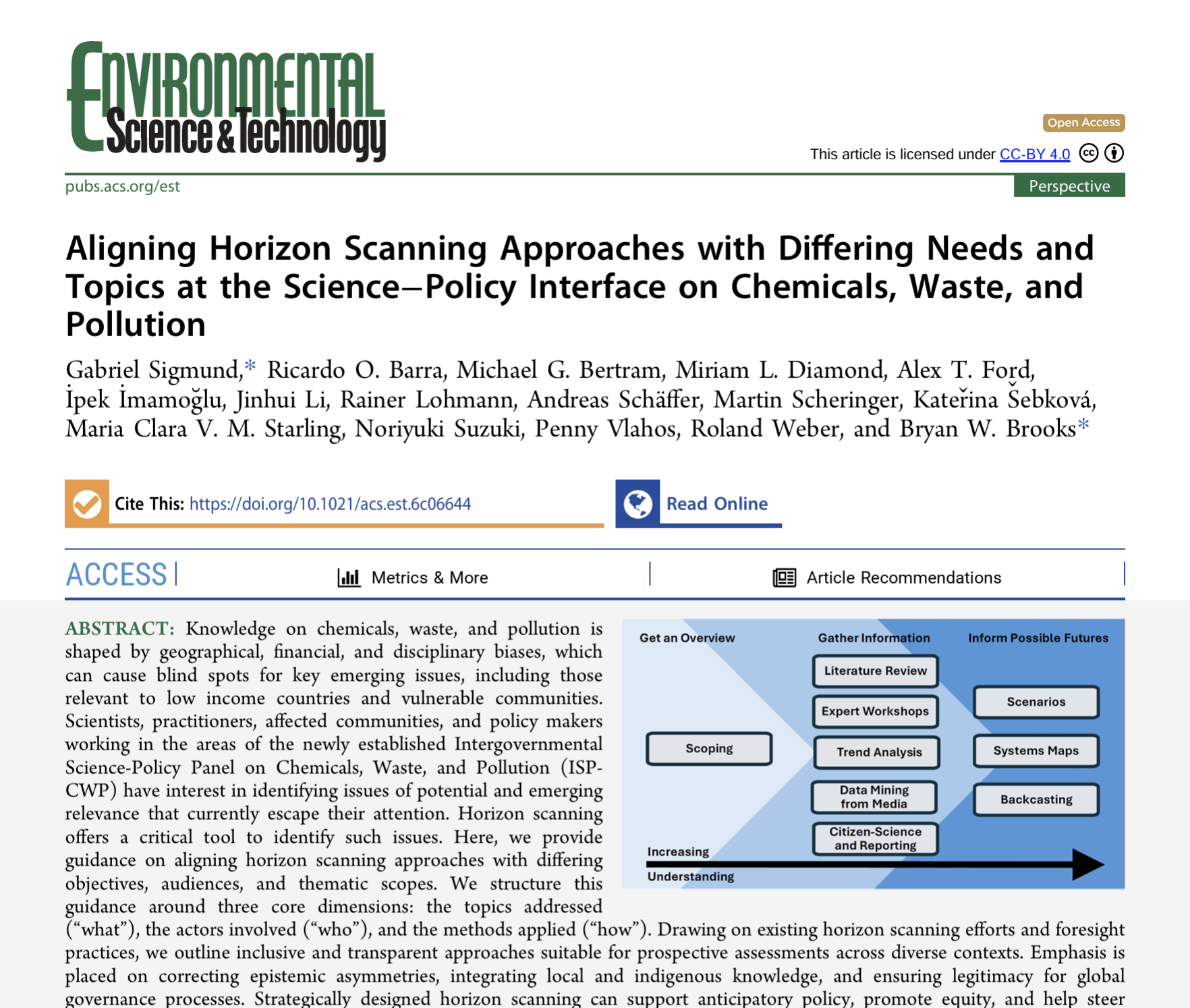
Knowledge on chemicals, waste, and pollution is shaped by geographical, financial, and disciplinary biases, which can cause blind spots for key emerging issues, including those relevant to low income countries and vulnerable communities. Scientists, practitioners, affected communities, and policy makers working in the areas of the newly established Intergovernmental Science-Policy Panel on Chemicals, Waste, and Pollution (ISP-CWP) have interest in identifying issues of potential and emerging relevance that currently escape their attention. Horizon scanning offers a critical tool to identify such issues. Here, we provide guidance on aligning horizon scanning approaches with differing objectives, audiences, and thematic scopes. We structure this guidance around three core dimensions: the topics addressed (“what”), the actors involved (“who”), and the methods applied (“how”). Drawing on existing horizon scanning efforts and foresight practices, we outline inclusive and transparent approaches suitable for prospective assessments across diverse contexts. Emphasis is placed on correcting epistemic asymmetries, integrating local and indigenous knowledge, and ensuring legitimacy for global governance processes. Strategically designed horizon scanning can support anticipatory policy, promote equity, and help steer collective action toward a livable planet for all.