Jarić, I., Blumstein, D.T., Prchalová, M., Cordero-Rivera, A., Ladle, R.J., Aleklett, K., Arlinghaus, R., Berger-Tal, O., Bertram, M.G., Brose, U., de Oliveira Caetano, G.H., Couzin, I.D., Diniz-Filho, J.A.F., Firth, J.A., Futamura, R., Gaston, K.J., Hortal, J., Karban, R., Keith, S.A., Lessa, T., López-García, P., Marske, K.A., Martins, E.P., Moreira, D., Ord, T.J., Pengal, P., de Oliveira Roque, F., Sbragaglia, V., Signaroli, M., Smederevac-Lalić, M., Snijders, L., Westrelin, S., Wong, B.B.M., Monk, C.T. In press. Behavioral diversity knowledge shortfalls in biodiversity conservation. Trends Ecol. Evol. https://doi.org/10.1016/j.tree.2026.09.002
ABSTRACT
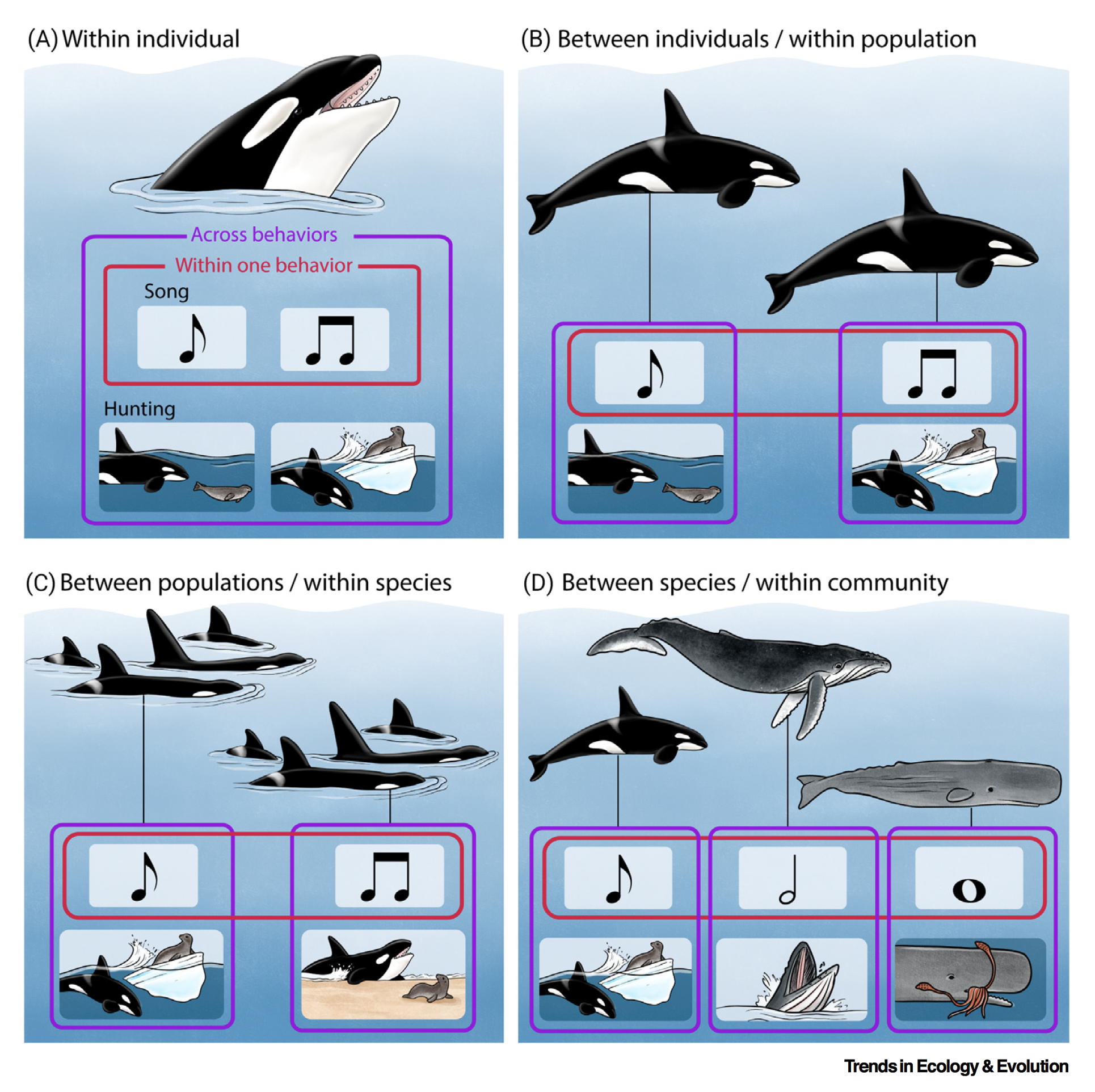
Behavior is a critical but underexplored component of biodiversity, often overlooked in conservation science, ecological restoration, and biodiversity management. We argue that behavioral diversity needs to be formally recognized as a distinct facet of biodiversity, given its critical value as a reservoir of adaptive potential, and that current gaps in knowledge should be acknowledged as what we formally define to be a behavioral diversity knowledge shortfall. Present knowledge shortfalls need to be confronted by establishing standardized behavioral diversity indicators, harnessing recent technological developments and large databases, building capacity, promoting interdisciplinary collaboration, and setting research priorities. Recognizing and reducing the behavioral diversity knowledge shortfall will help better explain existing biodiversity patterns and improve the outcomes of conservation actions.